

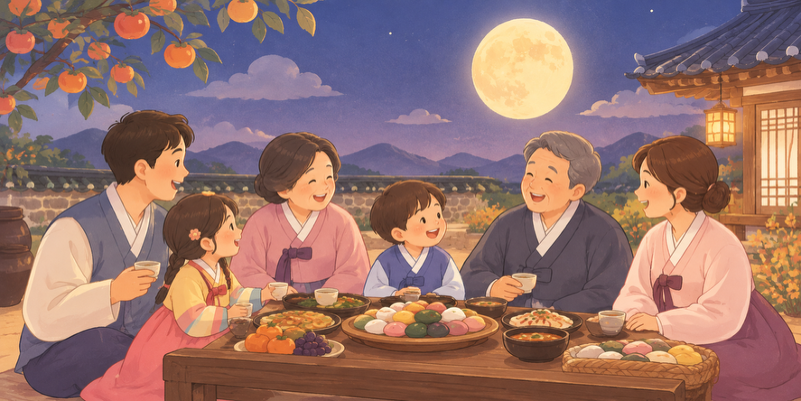
If you’re from Singapore, you probably know the Mid-Autumn Festival pretty well. Mooncakes, colourful lanterns, family gatherings and admiring the full moon. These are all familiar sights around this time of year. But did you know that Korea has its own major celebration around the same time?
It’s called Chuseok (추석), and it’s one of the biggest traditional holidays in Korea. Like the Mid-Autumn Festival, Chuseok falls on the 15th day of the eighth month in the lunar calendar and is connected to the harvest, the full moon and spending time with family. There are some fun similarities between the two, but Chuseok also has its own special food, traditions and customs that make it uniquely Korean.
In 2026, Chuseok fell on 25 September, with the holiday period running from 24 to 26 September. Around this time, many Koreans travel back to their hometowns to spend time with their families, which can make train stations, highways and airports especially busy! It’s a time to slow down, enjoy good food and reconnect with the people who matter most.
So, what actually happens during Chuseok?
For many Korean families, Chuseok is a chance to gather around the table and enjoy a big meal together. One of the most famous Chuseok foods is songpyeon (송편), a small rice cake traditionally made in a crescent-moon shape. Families may make songpyeon together, along with a variety of other traditional dishes.
Chuseok is also closely connected to remembering and honouring family members who have passed away. Some families hold charye (차례), a memorial ceremony for their ancestors, while others visit ancestral graves and tidy the surrounding area. Although these traditions may look quite different from a modern family gathering in Singapore, the idea of coming together and showing gratitude to family is something many people can relate to.
And, of course, just like Singaporeans have festive greetings for the Mid-Autumn Festival, Koreans have their own expressions for Chuseok too. One of the most common is:
추석 잘 보내세요!
Chuseok jal bonaeseyo!
→ Have a good Chuseok!
You might also hear:
즐거운 추석 보내세요!
Jeulgeoun Chuseok bonaeseyo!
→ Have a wonderful Chuseok!
Another lovely expression is:
풍성한 한가위 보내세요!
Pungseonghan Hangawi bonaeseyo!
→ Wishing you a bountiful and happy Chuseok!
한가위 (Hangawi) is another traditional name for Chuseok, so you may come across it in festive greetings, cards and messages.
And this is one of the fun things about learning Korean. The more you learn, the more these little cultural details start to make sense. A simple phrase like 추석 잘 보내세요 isn’t just a collection of Korean words. It connects you to a festival, a tradition and the way people celebrate together.
If you’ve been thinking about learning Korean but haven’t quite taken the first step, exploring Korean culture can be a fun place to start. At Sejong Korean Language School, we welcome learners at all levels, including complete beginners. Whether you’re looking into learning Korean for beginners, hoping to learn basic Korean in Singapore, or simply looking for a friendly Korean language centre to begin your journey, our Korean classes are a chance to learn the language while getting to know the culture behind it.
You don’t need to already know Korean, and you certainly don’t need to be an expert in K-dramas or K-pop! Just bring your curiosity and a little enthusiasm, and we’ll take it from there. 😊
추석 잘 보내세요! 🌕✨
Written by: Ms Park Youn Ha, October 2026