

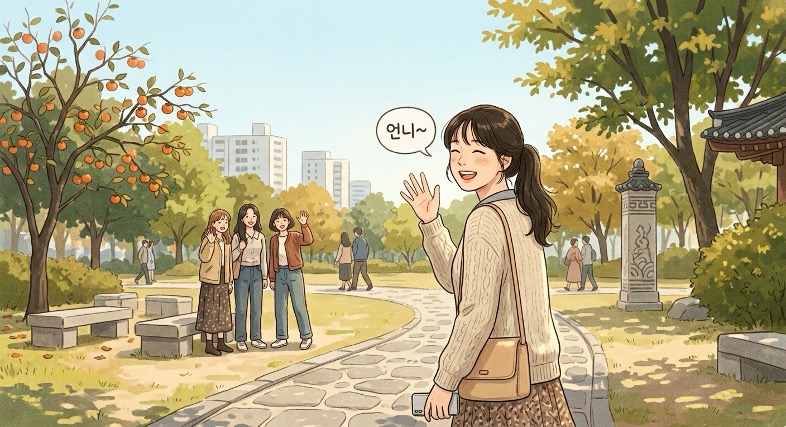
If you’ve ever watched a K-drama or started learning Korean, you’ve probably heard words like 언니 (unni), 오빠 (oppa), 형 (hyeong), and 누나 (nuna).
But have you ever wondered why Koreans don’t simply call everyone by their name?
In Korean, the way you address someone often depends on your relationship with them. Age, gender, familiarity, and social roles can all influence which word you use. In fact, understanding these titles is an important part of learning Korean naturally.
So, Who Is “Unni”?
언니 (unni) means “older sister” and is used by women when addressing an older woman. But they don’t have to be actual sisters! A younger woman might call an older female friend, colleague, or someone she’s close to 언니.
You’ll often hear:
언니, 뭐 해요?
“Unni, what are you doing?”
What About “Oppa”?
오빠 (oppa) is probably the most famous Korean title outside Korea, thanks to K-pop and K-dramas!
A woman uses 오빠 to address an older man she has a close relationship with. He could be her actual older brother, an older friend, or even her boyfriend.
But here’s the important part: 오빠 doesn’t simply mean “any older man.” The relationship matters. You wouldn’t normally call a random older man on the street 오빠!
And There’s “Nuna” and “Hyeong”
These two are used by men.
누나 (nuna) is what a man calls an older woman, while 형 (hyeong) is what a man calls an older man.
So, depending on who you are and who you’re talking to, the same person might be called 언니, 오빠, 누나, or 형.
These words show how the Korean language naturally reflects relationships between people.
What About “Ajeossi” and “Ajumma”?
You may also have heard 아저씨 (ajeossi) and 아줌마 (ajumma).
아저씨 is generally used to address a middle-aged or older man, while 아줌마 refers to a middle-aged woman.
You might hear these words used when speaking to strangers in everyday situations. However, 아줌마 can sometimes sound impolite or overly direct, especially when addressing a woman who may not want to be described by her age.
If you’re a Korean learner and want to learn basic Korean in a natural way, it’s useful to understand not only what these words mean, but also when they are appropriate to use.
It’s Not Just About Family
Korean titles extend far beyond words like 언니 and 오빠.
For example, 선배 (seonbae) or 선배님 (seonbaenim) refers to someone who has more experience or has been part of a school, university, workplace, or organisation longer than you. You’ll also hear 선생님 (seonsaengnim), which is commonly used for “teacher” but can also be used as a respectful form of address for certain professionals or even strangers in some situations. Lastly, 사장님 (sajangnim) for a business owner or boss.
Notice the -님 at the end? It adds respect to the title.
This is one of the things that makes Korean so interesting. You’re not only choosing words based on what you want to say, but sometimes also who you’re saying it to.
Learning Korean Means Learning the Culture Too
Korean is a language where relationships are often reflected directly in the way people speak to one another. So learning words like 언니, 오빠, 누나, 형, and 선배 isn’t just about expanding your vocabulary. It’s also a little window into Korean culture.
Understanding cultural context can help you learn to speak Korean more naturally and confidently. And if you’re hoping to learn Korean in Singapore, why not take the next step and explore what learning Korean can offer?
At Sejong Korean Language School, you can learn the language while also discovering the culture behind it.
Once you know who to call oppa… you’re already one step closer to sounding like a real Korean speaker!
Written by: Ms Park Youn Ha, September 2026